Done For You Marketing for Coaches: Honest Breakdown 2026
Most coaches build their business on referrals, word of mouth, and the occasional Instagram post. That works at first. Then it stops working, and nobody can explain why. The real question is: what marketing for coaches actually drives consistent, predictable growth?
The honest answer is that referrals are not a growth strategy. They are a byproduct of good work, which means you have no control over them and no way to scale them. If you want consistent clients, consistent revenue, and a business that grows without you working seven days a week, you need a real marketing system built on the right channels and services.
This guide breaks down every piece of marketing a coaching business needs. Not every coach needs all of it at once. But you do need to know what exists, what each piece does, and in what order to build it.
Quick Answer
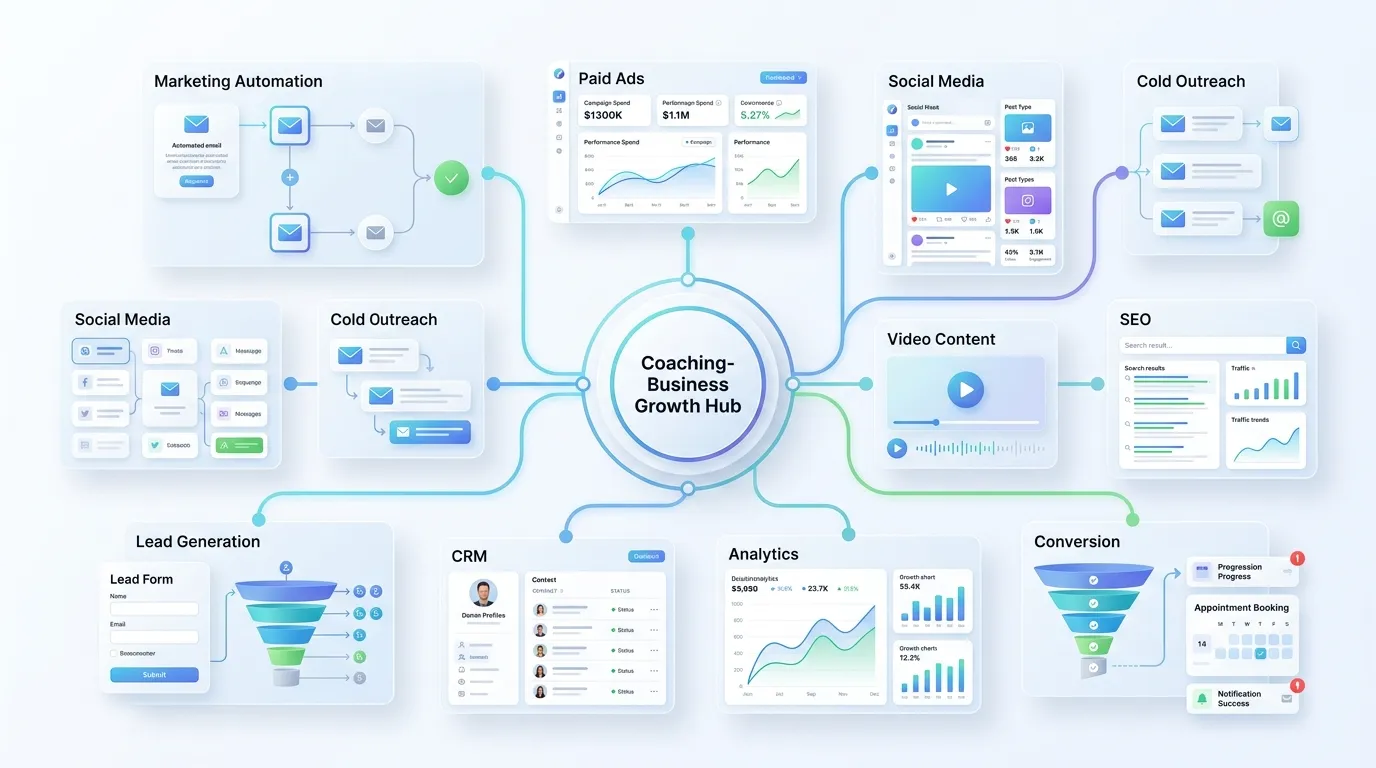
A coaching business needs five core marketing layers: a CRM and automation system to capture and follow up with leads, paid advertising or cold outreach to generate traffic, social media and video content to build authority, SEO for long-term visibility, and a consistent booking funnel to convert interest into discovery calls. |
Before you run a single ad or post a single piece of content, you need a system to capture leads and follow up with them automatically. Most coaches skip this entirely. They drive traffic to their page, get a form submission or a direct message, and then manually try to book a call. Leads go cold. Calls get missed. Revenue that should have closed just disappears.
The foundation of marketing for coaches is a CRM that tracks every lead and an automation system that does the follow-up for you. Setting this up correctly before spending on traffic is what separates coaching businesses that convert 5 percent of their leads from those that convert 20 percent.
GoHighLevel is the platform most coaching businesses use to manage this. It combines your CRM, email and SMS automation, booking calendar, and pipeline management in one place. When a new lead comes in, the GoHighLevel setup triggers an instant follow-up message, adds them to a nurture sequence, and moves them through your pipeline based on what they do next.
You configure it once. After that, it runs without you. Every lead gets contacted within seconds of opting in, followed up with over several days, and reminded about their booked call before it happens. That is the infrastructure every coaching business needs before investing in any traffic channel.
Once your foundation is in place, you need people flowing into it. There are two primary ways to generate leads as a coach: paid advertising and cold outreach. Each works differently and suits different stages of a coaching business.
Paid social media advertising is the fastest way to fill a pipeline. Facebook and Instagram ads let you put your offer in front of people who match your ideal client profile, regardless of whether they follow you or have heard of you before. A well-structured media buying campaign targets the right audience, shows them a compelling offer, and sends them into your CRM automation to be followed up with instantly.
The most common mistake coaches make with ads is running them before they have a working funnel. If the automation system is not in place, you are paying for leads that will never hear from you fast enough to convert. Build the foundation first, then run the traffic.
Cold outreach is the alternative for coaches who prefer not to run ads or who want to target a specific type of client directly. A structured cold outreach campaign across email and LinkedIn lets you reach decision-makers by name, with a message written specifically for their situation. When done correctly, it generates booked discovery calls without any ad spend.
Content is what builds trust between your audience and your offer. Coaches who post consistently, show their thinking, share client results, and demonstrate their expertise in short-form content convert significantly better when leads come into their funnel. Content is not a direct lead generation channel for most coaches. It is an authority channel.
The question is not whether you should post. It is what to post, how often, and on which platforms. A social media management system for a coaching business typically covers Instagram, LinkedIn, and TikTok. Instagram is better for visibility and audience growth. LinkedIn is better for reaching professionals, business owners, and corporate clients.
A content plan for a coaching business typically includes educational posts that teach something from your methodology, authority posts that share your results and client outcomes, engagement posts that start conversations, and promotional content that directs followers to book a call. The ratio matters. Most coaches post too much promotional content and not enough value-driven content, which is why their following does not convert.
Video is the most powerful format on every platform right now. Short-form video on Instagram Reels and TikTok reaches audiences far beyond your existing followers. Even a simple talking-head video recorded on your phone and edited professionally can perform better than polished branded graphics if the content is useful. Professional video editing makes the difference between content that looks credible and content that gets scrolled past.
Graphic design for coaches is the visual layer that ties all of your content together. Branded templates for social posts, carousel graphics, and promotional assets create a consistent visual identity that makes your content recognizable across every platform.
Platform | Best For | Content Type | Posting Frequency |
|---|---|---|---|
Audience growth and visibility | Reels, carousels, stories | 4 to 5 times per week | |
B2B clients and professionals | Articles, posts, video | 3 to 4 times per week | |
TikTok | Organic reach and discovery | Short-form video only | 5 to 7 times per week |
YouTube | Long-term SEO and authority | Long-form video, Shorts | 1 to 2 times per week |
Community and ads | Groups, posts, live video | 3 times per week |
Paid ads and social media bring traffic now. SEO for coaches brings traffic consistently over the long term without paying for every click. Search engine optimization is the process of making sure your website appears when potential clients search for the problems you solve. If you coach burned-out executives, you want to rank when someone searches for help with leadership stress or career transitions.
SEO takes time. Most coaching businesses start seeing measurable results within 3 to 6 months of consistent optimization. But once those rankings are established, they bring in qualified traffic every month without any ongoing ad spend. That is why SEO is worth building even when paid ads are already working.
You cannot do all of this at once. Most coaches who try to manage their own marketing alongside their client delivery end up doing everything poorly. The goal is to build the system in the right order and outsource the parts that do not require you to be personally involved.
Marketing Checklist for Coaches
CRM and lead tracking system in place Automated follow-up sequence running for every new lead Booking calendar connected and sending reminders automatically At least one active traffic source: paid ads or cold outreach Consistent social media content on 1 to 2 platforms Short-form video being produced and published weekly SEO keyword research completed for core service pages Execution outsourced for at least 2 to 3 of the above |
Summary
Every coaching business needs five layers of marketing to grow sustainably: a CRM and automation foundation, a traffic source such as paid ads or cold outreach, content across social media and video to build authority, SEO for long-term organic visibility, and a team or fulfillment partner to execute the work so the coach can focus on coaching. |
Most coaches focus on the visible parts of marketing: the Instagram posts, the ads, the landing pages. The invisible part is the system underneath that captures, nurtures, and converts the attention those channels generate.
When the system works, every piece of content you create, every ad you run, and every outreach message you send feeds into a machine that moves people toward booking. When it does not work, you are generating awareness with no way to convert it.
Build the foundation. Add the channels in order. Outsource the execution as soon as you can afford to. That is how a coaching business grows from inconsistent referrals to a full calendar with predictable revenue.
If you want to skip the trial and error and get the full system built for you, Tron Digital works with coaches to set up the automation, manage the content, run the ads, and handle the SEO. Book a free strategy call and we will map out exactly what your coaching business needs.
The most effective marketing channels for coaches are CRM automation for lead follow-up, paid social ads on Facebook and Instagram for traffic, LinkedIn for B2B clients, short-form video for audience growth, and SEO for long-term visibility. Most coaching businesses perform best when they focus on two or three channels rather than trying to manage all of them at once.
Paid ads are not required for every coaching business, but they are the fastest way to generate a predictable flow of discovery calls. The most important thing is having a working CRM and follow-up automation in place before running ads. Without automation, paid traffic rarely converts at a rate that justifies the spend.
A basic CRM and automation setup can be built for a few hundred dollars per month in tool costs. Paid advertising typically requires a minimum of $1,000 to $1,500 per month in ad spend for meaningful results. Full-service outsourcing covering ads, content, SEO, and automation is a larger investment but significantly faster than building everything in-house.
The first thing most coaches should outsource is their automation setup. Getting the CRM, follow-up sequences, and booking system built correctly is technical work most coaches are not trained for and should not spend time on. Once the foundation is automated, the second priority to outsource is content creation, specifically social media management and video editing.
Yes, but it is harder. Cold outreach and SEO can both generate consistent clients without social media. However, social media significantly accelerates trust-building with warm leads who come from other channels. Most coaching businesses that avoid social media entirely find that conversion rates on cold traffic are lower because there is no content for prospects to review before booking.
Follow Us: